
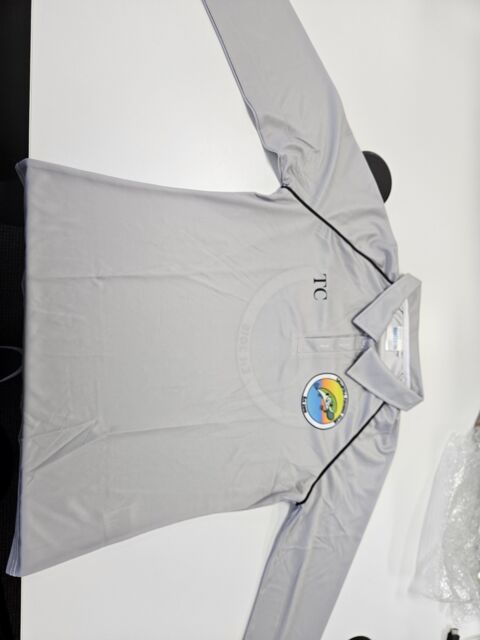
In May 2026, a Brisbane fishing club asked Custom T Shirt Printing Online to produce 50 lightweight long sleeve polos for members who regularly spend time outdoors in Queensland conditions.
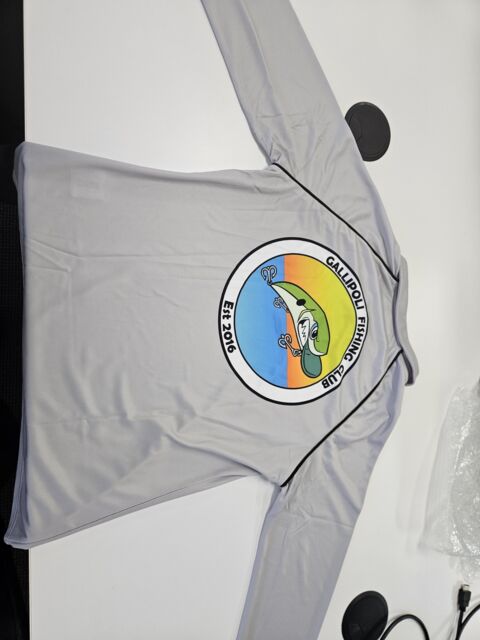
The order included a small full colour club logo on the left chest, the same logo printed much larger across the back, decorative piping and individual names on 42 shirts. The remaining eight shirts were ordered without names for latecomers and future members.
The club wanted the new shirts to look professional while remaining light, breathable and comfortable in warm weather. Their existing shirt gave us a visual reference, but it did not automatically tell us which garment or printing method would provide the best result.
After comparing DTG, DTF, screen printing and sublimation, we recommended custom cut and sew sublimated polyester polos. This method allowed the colourful artwork to become part of the fabric instead of sitting as a heavy transfer across the back.
The final order was completed successfully, individually packed and collected from our Stafford Heights location on Brisbane’s Northside. The customer was so pleased with the result that he tried on his own shirt in our office and took photographs before leaving.
Customer: Brisbane fishing club
The group consisted of men and women who wanted coordinated shirts for club activities, fishing trips and outdoor events.
Order quantity: 50 long sleeve polos
The order included 38 men’s garments and 12 women’s garments in several sizes.
Printing method: Cut and sew sublimation
This process was selected because it offered the best balance of colour reproduction, breathability, comfort and design flexibility.
Artwork placement: Small left chest logo and large back logo
The same circular fishing club design needed to remain clear at two very different sizes.
Personalisation: 42 individual names
Eight additional garments were left without names for members who had not placed their orders before the deadline.
Garment material: Lightweight polyester
The fabric was selected for active outdoor use and quicker drying performance.
Additional feature: Contrast piping
The customer wanted piping similar to the styling often seen on professional trade and teamwear garments.
Production started: 10 June 2026
Production began after artwork, sizes, names, mockups and payment had been finalised.
Completed order received: 13 July 2026
The order was completed within the expected production schedule.
Collection location: Stafford Heights, Brisbane
The customer collected the finished garments while traveling from Enoggera towards Murrumba Downs.
Custom T Shirt Printing Online helps fishing clubs, sporting teams, trades, businesses and community groups throughout Brisbane choose suitable garments and printing methods for bulk and personalised orders.
Local pickup is available from Stafford Heights, making it convenient for customers from Enoggera, Everton Park, Kedron, Chermside, Aspley, Albany Creek, North Lakes, Murrumba Downs and surrounding Brisbane areas.
The club needed 50 professional long sleeve polos that could display a detailed multicoloured logo without making the shirts heavy or uncomfortable.
The members planned to wear the garments while fishing and participating in outdoor club activities. That meant the shirts could be exposed to sun, warmth and humidity for extended periods.
A standard cotton polo was considered, but cotton can absorb perspiration and feel heavier as the day progresses. The club was looking for something more suited to active outdoor use.
The chosen garment needed to:
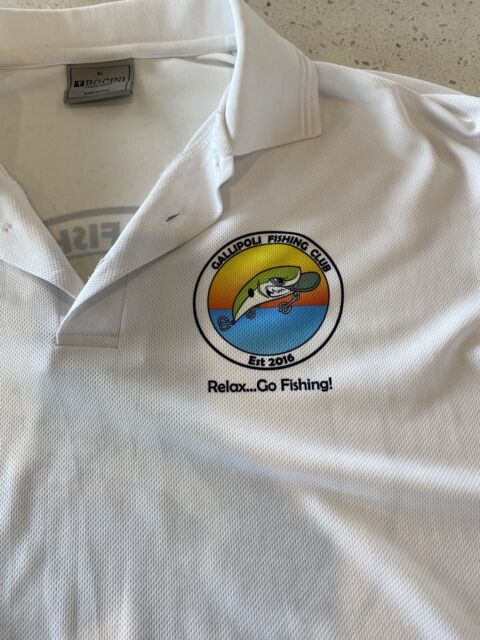
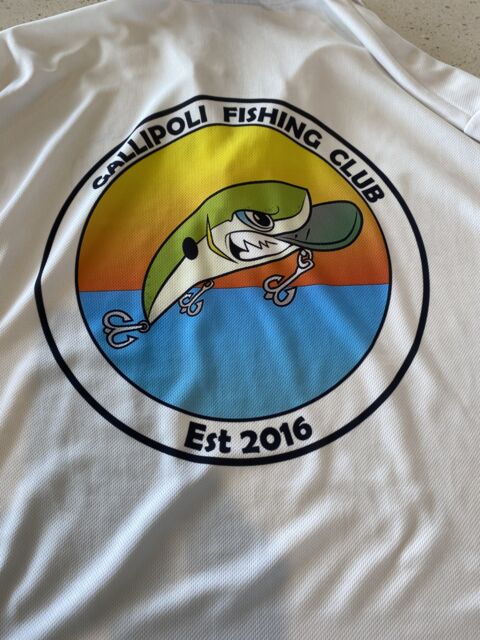
The artwork itself contained several colours. The circular club emblem included yellow, orange, blue, green, black and white sections with detailed lettering and a stylised fishing lure character.
The solution therefore had to protect both the appearance of the logo and the comfort of the people wearing it.
Every answer affects the garment recommendation, printing method, production schedule and final price.
Ordering 50 custom garments is not simply a matter of selecting a shirt and uploading a logo. Different fabrics react differently to printing processes. Large prints can change how a shirt feels and individual names create another layer of production detail.
Before recommending a solution, we asked the following questions.
The final quantity was 50 long sleeve polos.
Confirming the quantity allowed us to compare the cost and practicality of several printing methods. It also helped us check whether the supplier could complete the order within the required production window.
The customer supplied an existing light coloured shirt as a reference.
We also needed to confirm the colours in the club logo and the desired piping. The artwork included bright yellow, orange, blue and green areas with strong black outlines and white sections.
The order included 38 men’s shirts and 12 women’s shirts.
Men’s and women’s garments use different patterns and sizing systems. Keeping those lists separate was essential for ordering the correct quantities and matching each personalised name with the right garment.
The client supplied basic versions of the club logo.
The images were useful as a reference but needed to be converted into professional production files. We prepared the artwork in PDF and EPS formats so the printing team could scale it cleanly for the chest and back.
The customer wanted a small logo on the left chest and a much larger version across the back.
Forty two garments also required a member name or initials on the right chest.
The customer selected long sleeve polos.
The collar, button placket, contrast piping and long sleeves gave the group a more professional club appearance than a standard T shirt.
We needed to make sure the required date was achievable before accepting the order.
The customer was advised that custom sublimated garments generally take approximately six to eight weeks because the fabric panels are printed before the shirts are cut and assembled.
The customer arranged to collect the completed garments from Stafford Heights.
This removed the need to allow extra time for freight after the order arrived in Brisbane.
The customer could choose bank transfer or credit card.
He selected bank transfer. Full payment was requested after the digital mockups had been approved and before production began.
Cut and sew sublimation provided the best balance of comfort, design quality, personalisation and long term suitability.
We did not recommend sublimation immediately. We first considered DTG, DTF and screen printing to determine whether any of those methods could deliver the desired result at a suitable price.
The right printing method depends on the garment fabric, order quantity, number of artwork colours, print size, required finish and how the shirts will be worn. In this fishing club project, we compared DTG, DTF, screen printing and sublimation before recommending the option that offered the best balance of comfort, breathability and full colour reproduction.
Compare DTG, DTF and screen printing before placing your order
No. DTG was not suitable for the fabric, garment structure or overall production requirements.
Direct to garment printing is commonly used for suitable cotton garments. It can reproduce detailed images and works well for many small custom T shirt orders.
However, the client wanted lightweight polyester long sleeve polos rather than cotton T shirts.
We also do not offer DTG printing on customer supplied garments because the exact fabric composition, coating and previous treatment may affect the finished print.
DTG would not provide the same custom panel printing and garment construction options available through cut and sew sublimation.
Yes. DTF could reproduce the colours and detail, but the large back transfer could reduce comfort.
Direct to film printing applies a printed transfer to the surface of a completed garment. It is an effective choice for many uniforms, promotional shirts and event garments.
The small chest logo would not have created a major comfort issue. The large back logo was different.
A broad DTF transfer sits on top of the fabric and covers part of the breathable surface. When worn outdoors in warm Queensland conditions, that section can feel warmer than the surrounding fabric.
The design could have been printed successfully, but technical success was not the only consideration. We also needed to think about how the shirt would feel after several hours in the sun.
For that reason, DTF was not our preferred recommendation.
When is DTF printing a better option?
DTF remains an excellent choice for many custom garments, especially when you need detailed full colour artwork on standard T shirts, polos, hoodies or workwear. Learn more about DTF printing for custom garments and when it may suit your order better than sublimation.
The design contained several colours and the large printed area could have affected both pricing and garment comfort.
Screen printing is often a strong option for larger quantities when the artwork uses a limited number of solid colours.
This club logo contained yellow, orange, blue, green, black and white details. Each additional colour can increase the number of screens and the amount of setup required.
The large back design would also require significant ink coverage. While the print could be produced, the decorated area could feel heavier than the customer wanted for active outdoor use.
Screen printing was therefore possible but did not offer the best combination of comfort, colour reproduction and value for this particular project.
Sublimation allowed the design to become part of the polyester fabric without creating a heavy layer across the back.
In cut and sew sublimation, the individual polyester garment panels are printed before they are cut and assembled into the finished shirt.
This differs from applying a transfer or ink layer to an already manufactured polo.
The process gave the fishing club several important advantages.
The artwork did not create a thick surface layer across the back. This was important for members spending long periods outdoors.
Because the colour became part of the polyester fibres, the large logo did not form the same type of surface barrier as a broad transfer.
Yellow, orange, blue, green, black and white elements could be included without creating a separate screen for every colour.
The same logo could be placed as a smaller chest emblem and as a large back feature.
Forty two shirts were personalised during the production process.
The contrast piping created a more distinctive club uniform.
It offered the lighter and quicker drying performance the customer wanted.
Cut and sew sublimation is a production process in which individual polyester garment panels are printed before being cut and stitched into finished shirts.
This process provides more design freedom than applying a print to a completed blank garment.
It can be used for:
Sublimation is particularly useful when the design includes several colours, large artwork or personalised elements.
It is not normally used for standard cotton shirts because the sublimation process is designed to bond with polyester fibres.
Sublimation was the best choice for this fishing club order because the full colour design became part of the lightweight polyester fabric instead of sitting as a heavy layer on top. This helped preserve comfort, breathability and colour detail across both the small chest logo and large back design.
Learn more about sublimation printing for custom shirts and teamwear
Yes. We supplied two DTF alternatives so the customer could compare price, fabric and comfort before deciding.
Offering more than one option allowed the client to understand the difference between printing on a completed garment and creating a custom sublimated polo.
The AS Colour Chad long sleeve polo was the cotton option.
The proposed decoration included a small DTF print on the front and a large DTF print on the back.
For 40 or more garments, the quoted unit price was $38.89 plus GST.
The garment offered a familiar cotton feel. However, cotton can retain more moisture than a performance polyester fabric and the large back transfer would still reduce airflow through the decorated section.
The Stencil Cool Dry long sleeve polo was a quick drying polyester alternative.
It also included a small DTF front print and a large DTF back print.
For 40 or more garments, the quoted unit price was $44.98 plus GST.
The base garment was suitable for active use, but the large back transfer would still sit on the surface of the fabric.
The custom sublimated option provided the best overall result.
It delivered the lightweight performance, full colour printing, individual personalisation and professional garment styling the club wanted.
The comparison helped the customer see that the lowest initial price was not automatically the best long term value.
Not completely. The customer supplied useful reference images, but professional artwork preparation was needed.
The same circular logo had to work as both a small chest emblem and a large back feature.
A low resolution image may appear acceptable on a phone or computer screen but become blurred or pixelated when enlarged. Small lettering can also lose clarity if the file is not prepared properly.
We converted and prepared the logo in PDF and EPS formats.
The artwork process included checking:
Digital mockups were then supplied for approval.
The customer could review the proposed garment before full payment and production.
Low resolution images, incorrect file formats and artwork that cannot be enlarged cleanly can delay a custom shirt order or affect the finished print quality. Before submitting your logo or design, review our artwork requirements for PNG, PDF, EPS, AI and other print ready files.
The client supplied a clear spreadsheet showing each member’s name, the wording required on the shirt and the correct size.
This was one of the most valuable parts of the ordering process.
Personalised bulk orders become difficult to manage when names and sizes are submitted through separate emails, messages or handwritten notes. A single spreadsheet creates a central reference for everyone involved.
The spreadsheet allowed us to match:
Customers planning teamwear should prepare one final spreadsheet with columns for:
The group should check the spreadsheet carefully before it is submitted for production.
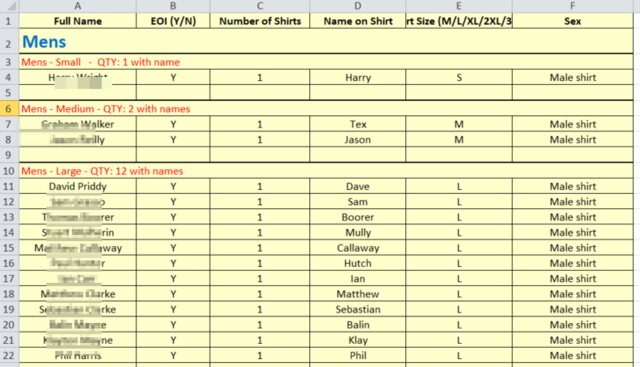
The order contained 38 men’s polos and 12 women’s polos.
This breakdown shows why bulk orders need to be checked carefully.
The order was not simply 50 identical garments. It involved two garment cuts, six men’s size categories, two women’s size categories and 42 personalised names.
The total for this specific order was $2,817.65 including GST.
The breakdown was:
The unit price was $42.93 plus GST.
The piping was added to create a more distinctive trade and teamwear appearance.
Each personalised name was charged at $5.00 plus GST.
The supplied logo was prepared in PDF and EPS production formats.
Pricing disclaimer: These prices relate only to this completed 2026 project. They should not be treated as current advertised pricing because garment, production, freight and supplier costs can change.
Production began on 10 June 2026 and the completed order arrived on 13 July 2026.
The client had already been advised that custom sublimated garments generally require six to eight weeks.
Sublimation can take longer than printing a standard blank garment because the project includes artwork preparation, panel printing, cutting, stitching, inspection and transport.
The stages had to be completed in the correct order:
If the size list, name list or artwork approval had been delayed, the production start date would also have moved.
Full payment was requested after the client approved the final digital mockups.
The customer selected bank transfer instead of credit card.
Once payment was received, the production order was placed with our overseas print partner.
This process gave the customer an opportunity to inspect the proposed artwork, layout and personalisation before manufacturing began.
It also ensured that the printing team received approved instructions before producing custom garments that could not easily be changed later.
Each polo arrived individually folded and sealed in a clear protective bag.
The individual packaging helped keep the shirts clean, organised and easy to distribute to members.
It also created a professional first impression when the order was opened.
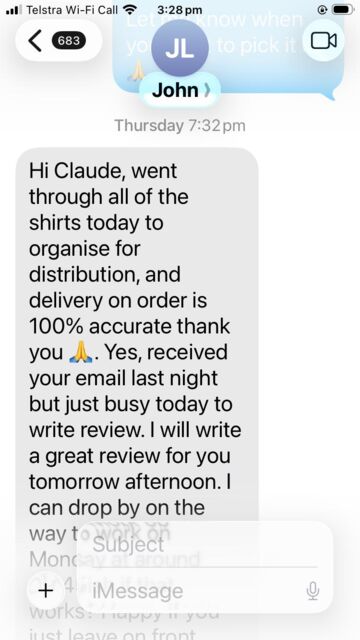
After checking the finished garments, we emailed the client to confirm that the order was complete and ready for collection.
The customer travelled from the Enoggera army barracks and collected the shirts from Stafford Heights while heading home towards Murrumba Downs.
Our Brisbane Northside location is convenient for customers from areas including:
Custom T Shirt Printing Online also assists clubs, teams and businesses throughout Queensland and across Australia.
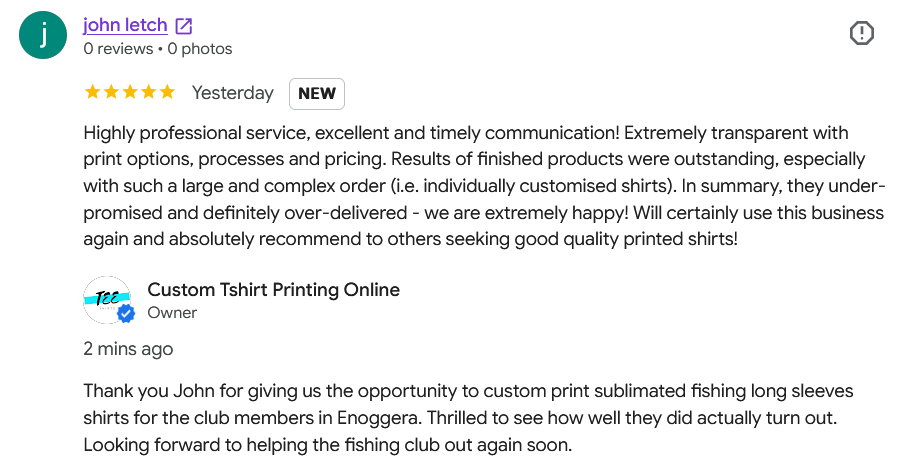
Yes. He was extremely happy with the appearance, fit and presentation of the garments.
The customer tried on his own shirt in our office and took photographs while wearing it.
That reaction showed that the time spent comparing methods, preparing the artwork and coordinating the personalised details had been worthwhile.
The club received lightweight garments that looked professional and were more suitable for outdoor use than shirts carrying a large surface transfer.
We did not recommend a process simply because it could reproduce the artwork.
We considered where the shirts would be worn, how large the back image would be and how the decorated area could feel after several hours outdoors.
The logo needed to remain readable on the chest and visually strong across the back.
Preparing suitable production files helped avoid blurred outlines, pixelated graphics and illegible lettering.
Men’s and women’s polos use different patterns.
Keeping the garment types clearly separated reduced the risk of ordering the wrong fit for a member.
Forty two personalised names created a greater risk of human error.
The customer’s spreadsheet gave us a clear and organised production reference.
The customer was told that the order would require approximately six to eight weeks.
Clear expectations prevented unnecessary pressure and allowed the project to move through each stage properly.
We checked whether the required garment styles, sizes, colours and production capacity were available before proceeding.
A promised date is only useful when the production partner can realistically meet it.
Prepare the quantity, size breakdown, artwork, personalised name list and required date before production begins.
The following steps can make a bulk sublimation order easier.
Allow approximately six to eight weeks for custom cut and sew garments. Extra time may be needed during busy production periods.
Fishing, soccer, rugby, football and trade work can involve heat and physical movement. The garment should be selected for the environment where it will be worn.
Keep names, garment cuts and sizes in one document. Ask every member to confirm their details before the file is submitted.
Printed names will be produced according to the approved list. Confirm abbreviations, initials and capitalisation before production.
EPS, AI and print ready PDF files are preferred for logos. High resolution PNG files may also be suitable depending on the design.
Check artwork placement, scale, colours, personalisation and garment features. Compare the mockups with the written order details.
A cheaper method may create a garment that is less comfortable for the intended use. The best value comes from selecting the right combination of fabric and decoration.
Bulk custom printing can become confusing when an order includes different garment cuts, several sizes, large artwork, individual names, piping and a firm production schedule.
No customer should be expected to understand every technical difference between DTG, DTF, screen printing and sublimation.
Meet Claude Fullinfaw, owner of Custom T Shirt Printing Online and an experienced guide for customers planning personalised garments.
We ask the questions, explain the available options and help customers choose the printing method that best suits the artwork, garment, budget and intended use.
We do not treat complex requests as too hard.
Bulk garment orders can involve different shirt styles, size ranges, individual names, artwork preparation and firm production deadlines. Our bulk custom shirt printing service across Australia helps clubs, teams and businesses organise these details before production begins.
Custom T Shirt Printing Online compares the garment, printing method, quantity and intended use so customers can avoid unsuitable fabrics, uncomfortable prints and preventable ordering mistakes.
We look for practical ways to deliver a professional outcome for:
Our job is not simply to place a print on a shirt. It is to help the customer avoid choosing the wrong garment or printing method before production begins.
Provide the quantity, garment style, artwork, print positions, required date and size breakdown.
Include a spreadsheet when individual names are required.
We compare suitable garment and printing options before preparing a tailored quote.
Digital mockups are supplied once the preferred solution has been selected.
Check the artwork, names, sizes and garment details.
Once approval and payment are received, the order can proceed into production.
A successful bulk sublimation order starts with clear quantities, accurate size lists, suitable artwork, personalised names and enough production time. Follow our step-by-step guide to prepare the information needed before requesting a quote.
Ordering teamwear becomes complicated when you need multiple sizes, full colour artwork, individual names and a firm delivery date.
Custom T Shirt Printing Online can help you compare the garment, printing method and production options before you commit.
Send us your:
For professional advice and a tailored quote, call 0422 440 029.
Pickup is available from 12 Mumbil Street, Stafford Heights, Brisbane and Australia wide orders are welcome.
The prices shown in this case study relate specifically to the 50 shirt fishing club order completed in 2026.
Every custom order is different.
Current pricing may vary according to garment quantity, fabric, size range, design coverage, piping, personalisation, artwork preparation, production timing, delivery requirements and supplier costs.
Please request a current quote from Custom T Shirt Printing Online for the best pricing based on your project.
Cut and sew sublimation is a process in which individual polyester garment panels are printed before being cut and stitched into finished shirts.
This allows large designs, multiple colours, names and other details to be incorporated without applying a heavy transfer to the completed garment.
Yes. Sublimation is well suited to fishing shirts because it supports lightweight polyester fabrics, bright colours and large printed areas.
It is particularly useful for clubs requiring long sleeves, member names, sponsor logos or designs across the front and back.
Sublimated polyester shirts can remain breathable because the printed design becomes part of the fabric fibres.
The final comfort also depends on the fabric weight, construction, fit and ventilation of the selected garment.
Custom cut and sew sublimated garments generally require approximately six to eight weeks.
The exact timeframe depends on artwork approval, size confirmation, personalisation, supplier capacity, production complexity and freight.
Yes. Individual names or initials can be included on sublimated garments.
Customers should supply one final spreadsheet matching every printed name with the correct garment type and size.
Sublimation is often the better option when the garment is polyester and breathability is important.
A DTF transfer sits on the fabric surface. A large transfer may feel warmer because it covers part of the breathable material.
Vector artwork such as EPS, AI or print ready PDF files is preferred for logos.
High resolution PNG files may also be suitable. Low resolution images may require professional artwork preparation before production.
Yes. Custom T Shirt Printing Online helps clubs, teams, schools, trades and businesses throughout Australia.
Delivery pricing and timing depend on the quantity, destination and production schedule.
