
Project summary: A Brisbane Northside customer needed more than 80 photographs, messages and symbols printed for a personalised memory quilt. We used DTG printing across nine printable panels on five natural cotton shirts. By printing both sides and selecting the standard turnaround, the customer paid $161.40 and saved $52.25 compared with Same Day Dispatch.
Photos printed on fabrics for quilts can turn family photographs, personal messages and important milestones into sewable fabric pieces that become part of a lasting keepsake. This Brisbane Northside case study shows how more than 80 photographs, symbols and short messages were prepared, printed onto natural cotton and hand sewn into a quilt celebrating more than 50 years of one man’s life.
The customer did not begin with print ready artwork or a technical production plan. She began with a heartfelt idea.
She wanted to create a quilt for her partner using childhood photographs, family memories, military references, travel experiences and symbols connected with important stages of his life.
The challenge was finding a practical way to print everything onto fabric without making the finished quilt look shiny, stiff or commercially mass produced. The project also required enough unprinted fabric around each image so the customer could cut out every piece and sew it onto the quilt.
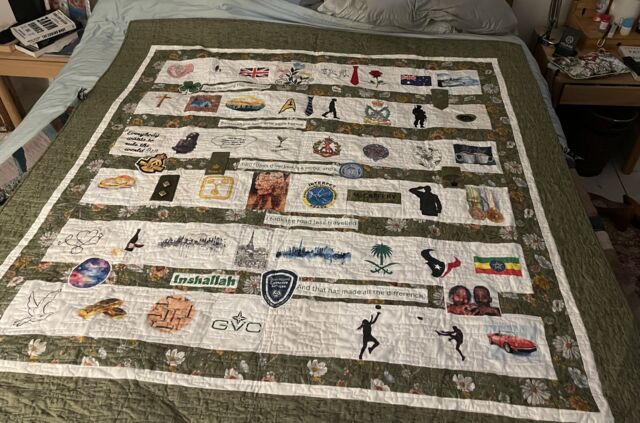
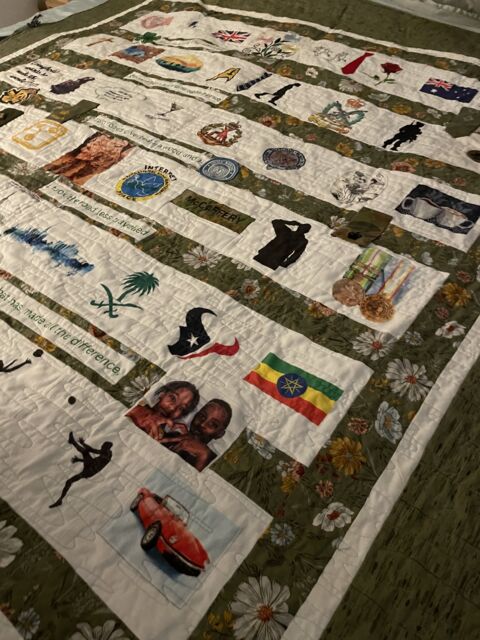
The customer wanted to create a personalised quilt that told her partner’s life story from childhood through to his late fifties. The finished quilt would be both a practical bed covering and a piece of family history.
She first approached us approximately 12 months before the project was completed. Her collection included old black and white photographs, recent colour photographs, military references, flags, medals, travel memories, personal sayings and family images.
The quilt was planned as a visual timeline. Earlier memories appeared towards the top while later sections represented adulthood, military service, travel, family relationships and other important experiences.
The finished quilt photographs show how the printed pieces were combined with cream cotton panels, green floral fabric, stitched borders and genuine memorabilia. The result looks handmade because every image, phrase and symbol was carefully positioned within the larger patchwork design.
The complete quilt fabric could not be printed directly because the DTG machines use fixed garment printing plates. Each plate holds a garment section of approximately 40 cm by 50 cm so the printable area remains flat beneath the print heads.
A complete quilt cover is much larger than this printable area. Loose fabric could wrinkle, move or sit unevenly during printing, leading to poor alignment and inconsistent results.
Rather than tell the customer the project could not be done, we changed the production strategy.
Cotton T-shirts were used as stable printable fabric carriers. Several images were arranged on each printable panel, then printed onto the front and back of the shirts. The customer could later cut the individual photographs and graphics from the garments and sew them into the quilt.
This is where personalised printing advice becomes valuable. Customers should not need to understand print plates, file formats and production limitations before asking for help.
DTG printing was chosen because it produced detailed photographs with a softer and more natural appearance on cotton. This finish suited a handmade memory quilt better than a shiny transfer sitting prominently on top of the fabric.
DTF and vinyl are excellent options for many T shirts, uniforms and bold graphics. For this project, however, more than 80 separate images would have needed to be positioned and heat pressed.
That process could have increased labour, added surface shine and made the finished quilt feel louder or more commercial than the customer intended.
DTG could also reproduce raster artwork such as transparent PNG files. The photographs did not need to be converted into vector graphics, which helped preserve faces, shadows, colours and details in the older black and white images.
Because the digital files had transparent backgrounds, only the photographs, wording and symbols were printed. The surrounding natural cotton remained visible and became part of the sewing allowance.
Because this project involved old black and white photographs, recent colour images and fine personal details, DTG printing for detailed photographs on cotton provided the softer and more natural finish needed for the memory quilt.
DTF printing is an excellent option for bold, colourful designs on many garment types. However, DTG was more suitable for this quilt because the customer wanted a softer appearance without the additional surface feel or shine of a heat-applied transfer.
More than 80 images were prepared by grouping them onto digital layouts measuring 3000 px by 4000 px. Canva was used to organise the photographs, captions and symbols within the available printable area.
Each layout had to balance three requirements:
Placing the images too far apart would waste printable fabric. Placing them too close together would leave the customer without enough material to cut around each image.
Visible natural fabric was deliberately left between the photographs, wording and graphics. This allowed the quilt maker to cut each element without damaging the printed design.
The extra blank fabric could then be folded under, stitched through or included within a larger patch.
Short messages were also printed beside selected images. These identified people, places, events or memories and helped the finished quilt tell a story rather than becoming a random collection of pictures.

Customers planning a similar project should review the artwork guidelines for custom printing before submitting their files. Clear, high-resolution photographs give the printer more flexibility when resizing images and arranging them across the available print area.
Digital mockups were important because they allowed the customer to review every layout before printing began. No print order was placed until the customer approved the image arrangements, wording, spacing and general appearance.
This approval process helps identify:
Correcting a digital mockup is easier and less costly than discovering an error after the images have been printed.
Once the mockups were approved, an invoice was sent. Production began after payment was received.
Natural Gildan Heavy Cotton T shirts in size XL were used because they offered a reliable cotton printing surface and a useful printable area on both sides. The natural colour also suited the cream, green and archival tones used in the completed quilt.
The garments were not intended to be worn after printing. They were being used as source fabric.
Once the printed sections were cut from the shirts, the remaining garments were expected to resemble scrap fabric. This was explained as part of the project plan.
Using a known cotton garment reduced production uncertainty. The shirts could be positioned correctly on the DTG printing plates instead of experimenting with a large piece of loose customer-supplied fabric.
We selected natural-coloured Gildan Heavy Cotton T shirts because the cotton surface worked well with DTG printing and the XL garment provided a useful printable area on both the front and back.
Printing both sides reduced the garment requirement from approximately nine shirts to five. Four shirts were printed on the front and back while the fifth shirt was printed on one side.
This produced nine printable panels:
A basic one-sided approach would have required nine shirts to produce the same number of panels.
Using both sides avoided purchasing four unnecessary garments. It reduced material use and lowered the customer’s overall investment without reducing the number of photographs that could be printed.
This is the type of saving that comes from understanding how the printed fabric will be used after production.
The customer saved $52.25 AUD by selecting the standard two week turnaround instead of Same Day Dispatch. The discounted standard order cost $161.40 AUD while the same supply and printing requirement through Same Day Dispatch would have cost $213.65 AUD.
| Printing requirement | Quantity | Two week turnaround | Same Day Dispatch | Customer saving | Percentage saving |
|---|---|---|---|---|---|
| Gildan Heavy Cotton T shirt printed two sides | 4 | $138.31 | $180.11 | $41.80 | 23.21% |
| Gildan Heavy Cotton T shirt printed one side | 1 | $23.09 | $33.54 | $10.45 | 31.16% |
| Total order | 5 shirts | $161.40 | $213.65 | $52.25 | 24.46% |
The customer paid an average of $32.28 per shirt through the standard turnaround.
The average through Same Day Dispatch would have been $42.73 per shirt, creating an average saving of $10.45 per garment.
The total saving was:
$213.65 minus $161.40 equals $52.25 AUD.
This means the customer saved 24.46% against the Same Day Dispatch total.
Looked at from the other direction, choosing Same Day Dispatch would have made the order approximately 32.37% more expensive than the standard two week option.
Urgent printing is valuable when a deadline cannot move. This customer had approximately six months to complete the quilt, so there was no practical reason to pay more for rush production.
By planning ahead, she protected her budget and still had approximately five months to cut, arrange and hand sew the printed pieces.
The same five-shirt order through the Same Day Dispatch printing service would have cost $213.65 AUD. By allowing the standard two-week turnaround, the customer paid $161.40 AUD and saved $52.25 AUD, or 24.46%.
The finished quilt combined printed photographs, illustrated symbols, flags, quotations and genuine memorabilia within long cream-coloured story panels. Green floral fabric separated each row and created a consistent visual frame around the different periods of the recipient’s life.
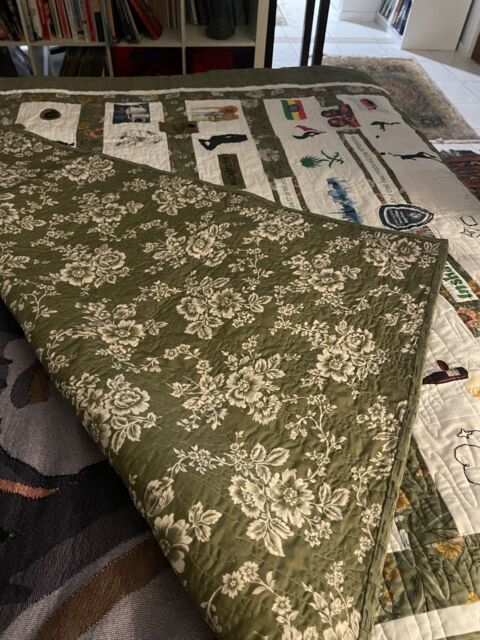
The project photographs show the completed quilt laid across a bed. Multiple horizontal rows run through the centre, surrounded by floral borders and a deeper green outer section.
The printed elements include:
Some photographs were printed as larger feature panels while smaller symbols filled the areas between them. Short printed phrases acted as connecting lines between different memories.
The close-up photographs show why leaving space around the images was important. Each picture or graphic sits within a larger area of cream cotton, giving the quilt maker room to sew around it.
Quilting lines run across both printed and unprinted sections, visually joining the separate pieces into one finished textile.
The reverse uses green floral fabric that complements the borders on the front. This gives the quilt a finished appearance from both sides.
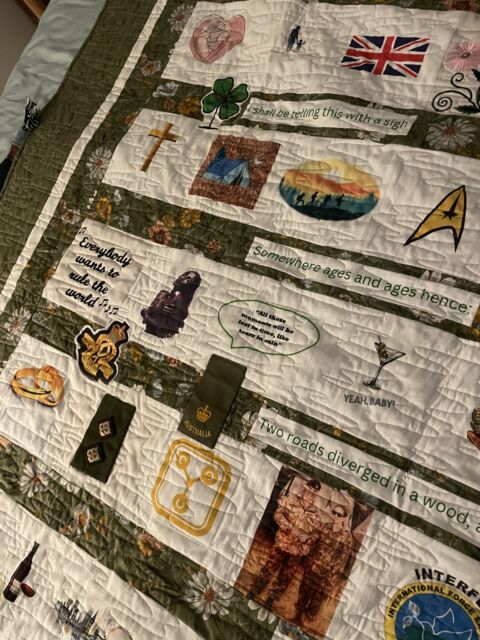
The customer cut the printed photographs and graphics from the garment panels, arranged them within the quilt design and hand sewed them onto the supporting fabric. She worked on the construction for approximately five months.
More than 80 printed elements had to be positioned carefully. Some were grouped into long horizontal panels while others became smaller individual patches.
Text strips were placed beside selected photographs so the meaning of each memory remained clear.
Military strips, medals and other physical items were also added. These genuine pieces created texture and connected the printed images with objects from the recipient’s actual life.
When her partner received the completed quilt, he was thrilled. The value was not only in the photographs. It came from the time, thought and personal knowledge used to create something that represented his life.
It was a quilt made to be seen, used and remembered.
Personalised advice matters because unusual sewing and craft projects rarely fit neatly into a standard online product form. Customers often know what they want to create but do not know how to prepare the files or select the printing process.
They may not know:
Custom T Shirt Printing Online acts as the guide by reviewing the idea, identifying the limitations and creating a practical production plan.
For this project, that meant recommending DTG, selecting natural cotton, preparing transparent PNG layouts, leaving cutting space, using both sides of the garments and choosing a standard turnaround.
The customer did not have to solve those technical problems alone.
Every printing job is logged so earlier decisions can be reviewed if a customer returns. The historical record may include artwork files, mockups, garment choices, print placements, previous pricing, delivery preferences and production notes.
This became especially useful when the customer returned in July 2026 to discuss another quilt. The new project was intended as an 80th birthday gift for her mother.
Rather than rebuilding the entire process, the previous job could be reviewed. We could see what had worked, which garment had been used and how the layouts had been prepared.
This type of continuity is often missing when customers order through large automated printing systems.
The ordering process begins with the final sewing project, image count, preferred patch sizes and required completion date.
Tell us whether the printed pieces will be used for a quilt, tote bag, cushion, journal cover or another item. Include the approximate finished dimensions and the date by which the full sewing project must be completed.
Send the highest quality versions available. Identify any photograph that must appear larger than the others and provide the exact wording for captions.
Check the image size, spacing, captions and arrangement before approving production. Printing does not begin without customer approval.
After approval, the invoice is issued. The job enters production once payment has been received.
Brisbane customers can arrange local collection. Customers elsewhere in Australia can use standard or express delivery and receive tracking after dispatch.
If a delay or misprint occurs, the customer is kept informed. We also follow up after collection or delivery to confirm the order arrived and met expectations.
Local Brisbane customers may be able to arrange collection, while interstate customers can have their printed garments sent through standard or express delivery. Review the shipping, collection, cancellation and returns information before placing an order so the delivery method can be included in the project plan.
Printed fabric patches can be used for many personalised gifts and sewing projects.
Photographs, dates and messages can document a relationship or milestone. The quilt can be organised by year, family branch or significant event.
Family photographs, handwriting and meaningful phrases can preserve the memory of a loved one. Careful colour selection can help the completed item feel personal and respectful.
Birth details, family photographs and messages can be printed onto sewable cotton panels. These can be combined with traditional patchwork pieces.
Bible verses, blessings and religious imagery can be printed alongside family photographs. The text must remain large enough to read after sewing.
A photograph or collection of symbols can become the feature panel on a practical accessory. The digital layout should be based on the maker’s cutting dimensions.
A smaller collection of memories can be used for a wall hanging, table runner or decorative quilt. These projects may require fewer panels than a full bed quilt.
Photographs, names, quotations and handwriting can personalise fabric book covers. Extra material must be allowed for seams, folds and closures.
Smaller items require carefully cropped images and readable text. Fine detail should not be reduced below a practical print size.
Customers across Brisbane and Australia can request help with photos printed on fabric for quilts. Brisbane areas commonly served include Stafford Heights, Chermside, Aspley, Kedron, Everton Park, Nundah, Albany Creek, North Lakes, Redcliffe and Brisbane City.
Customers do not need to live close to the printing location.
Artwork can be supplied digitally, mockups can be approved online and the completed printed panels can be shipped with tracking.
Start by collecting the photographs, wording and symbols that matter most. Then decide how the completed sewn item will be used and when it must be finished.
The earlier the printer understands the image count, patch size and deadline, the easier it is to reduce waste and avoid unnecessary urgent production.
Custom T Shirt Printing Online can help turn a folder of photographs into organised printable panels with enough room for cutting and sewing.
Call 0422 442 029 and ask to speak with Claude about the most practical way to complete your project.
The customer remains the creator of the finished quilt. Our role is to solve the printing problem, prepare the artwork correctly and supply printed fabric panels that give the craftsperson the best possible starting point.
This case study was written on 25 July 2026 by Claude Fullinfaw, who has helped customers organise custom printed designs since 2019 and has worked in business since 1986.
Have your photographs, wording and approximate patch sizes ready, then request advice and a personalised printing quote. Custom T Shirt Printing Online can review the project, recommend the most appropriate print method and help organise the images into practical panels for cutting and sewing.
Yes, photographs can be printed onto suitable cotton and cut into pieces for sewing onto a quilt. The fabric, printing method, image quality and required sewing allowance should be planned before production.
DTG is often suitable for photographic quilt patches printed onto cotton because it produces detailed images with a softer appearance. The best method depends on the fabric colour, image style and preferred finish.
Yes, old black and white photographs can be printed when the original scan contains enough detail. Dust, damage and low contrast may need to be corrected before enlargement.
No, photographs generally do not need to be vector files for DTG printing. High resolution PNG files can preserve faces, shading and natural colour changes.
Enough blank fabric should be left for the maker to cut and sew without touching the printed design. The exact allowance depends on whether the edges will be folded, appliquéd or stitched flat.
Yes, several photographs can be arranged on one panel to reduce waste and make production more economical. Each photograph must still have enough separation for cutting.
Yes, names, dates, locations and short explanations can be printed beside the photographs. The text should be brief and large enough to remain readable after sewing.
Sometimes, but the fabric must be compatible with the printing equipment and process. Large loose quilt panels may not suit garment based DTG machinery, so a printable cotton carrier may be recommended.
A memory quilt can include dozens of photographs, messages and symbols. The practical number depends on the quilt dimensions, patch sizes and space required around each element.
Standard production may take approximately two weeks after artwork approval and payment. Customers must also allow enough time for cutting, arranging and sewing the quilt.
Printed cotton patches can be used in washable projects when the printing method and construction are suitable. Gentle care can help protect the printed images, stitching and added memorabilia.
The printing company supplies the printed garment or fabric panels unless sewing has been arranged separately. In this case, the customer cut, arranged and hand sewed the printed pieces herself.
Printed photo fabric can be used for cushions, tote bags, mini quilts, table runners, journal covers, Bible covers, wallets, bookmarks, pot holders and tablet sleeves.
