
Calculate and optimize your commercial print budgets with our comprehensive breakdown of wholesale screen printing prices. Traditional screen printing relies on physical screen preparation, custom ink mixing, and carousel frame setups, making it the most cost-effective solution for high-volume custom apparel production. By aligning your order variables—such as total color breakdown, graphic dimensions, and garment styles—with our production tiers, you lock in low per-unit costs for corporate uniforms, event merchandise, promotional sportswear, and retail-ready collections across Australia.
| Order Volume Tier | Setup Mechanics | Best Use Case | Per-Unit Return on Asset (ROA) |
|---|---|---|---|
| 20 – 49 Units | Standard Screen Prep | Local Sports Teams & Small Events | Moderate Savings |
| 50 – 99 Units | Setup Amortization Begins | Mid-Scale Corporate Promos & Merch | High Efficiency |
| 100+ Units | Waived / Low Setup Impact | Large Conferences, Festivals & Uniforms | Maximum Bulk Discounts |
Leveraging advanced plastisol and premium water-based ink matrices, our trade-scale printing equipment processes high-density vector graphics into flawless, tactile apparel embellishments. Whether distributing promotional clothing nationwide or securing tight timelines with local distribution channels in Brisbane and beyond, understanding the structural pricing indicators below helps you select the exact production configuration required for maximum visual impact and bottom-line efficiency.
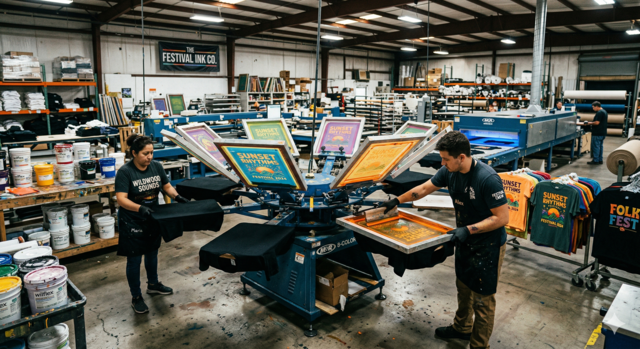
At Custom T Shirt Printing Online, we help buyers understand the real factors behind bulk screen printing pricing so they can make a confident decision before placing an order. Instead of guessing, you get clear advice on shirt type, quantity, print positions, artwork suitability, turnaround expectations, and the best way to move forward based on your budget and your goals.
If you want bulk screen printing done properly, with guidance that saves time and helps avoid confusion, this page will show you how pricing works and how to get the right result.
Bulk screen printing is an industrial apparel decoration method that utilizes mesh stencils and high-viscosity inks to replicate a single graphic layout across large volumes of garments. This automated or manual commercial production pipeline relies on photographic emulsion exposure to burn artwork geometries onto fine woven mesh screens, transferring precise layers of plastisol or water-based pigments onto base apparel substrates via mechanical squeegee pressure.
Bulk screen production stands as the definitive logistical choice for corporate brand updates, large-scale community sports club kits, educational uniform allocations, promotional product merchandise drives, and high-visibility event apparel coordination where maximum color vibrancy and volume-cost optimization are required.
A bulk t-shirt order generally starts at 20 units or more where a uniform design layout is applied across the entire print run. While order thresholds vary depending on specific institutional needs, this standard quantity marks the definitive mechanical efficiency baseline where commercial print methods become highly cost-effective compared to single-unit setups.
Ordering 20 to 49 custom printed shirts is a practical starting point for smaller groups that still want a professional finish. This range suits local sports teams, small businesses, school groups, family events, charity days, hens and bucks parties, and memorial shirts. It gives you enough quantity to keep pricing sensible while still being manageable for smaller campaigns, team uniforms, or one-off events.
The 50 to 99 shirt range is one of the best options for balancing price, quality, and flexibility. It is a popular choice for business uniforms, promotional giveaways, school events, club merchandise, trade shows, and community campaigns. At this quantity, setup costs are spread across more shirts, which usually brings down the price per shirt and makes bulk t-shirt printing more cost-effective.
Ordering 100 to 199 printed t-shirts is ideal when you need consistent branding across a larger group or event. This range works well for festivals, corporate teams, volunteer groups, school houses, sports clubs, fundraising campaigns, and larger staff uniform orders. It gives you better value per shirt while helping maintain a consistent look across every garment in the order.
For large bulk t-shirt printing orders, 200 or more shirts will usually deliver the lowest price per unit. This quantity is suited to major events, national promotions, large workplace uniform rollouts, retail merchandise, festivals, conferences, and ongoing brand campaigns. If you need a large number of shirts with the same design, this is often the most economical way to order.
Commercial procurement decisions for volume custom apparel rely heavily on transparent pricing structures to mitigate production risks and maximize return on investment (ROI). Procurement managers, corporate event coordinators, and apparel brands search for detailed bulk screen printing quotes not simply to locate low-cost options, but to prevent costly logistical errors, design degradation, or unexpected setup fees.
Navigating the custom garment manufacturing sector can present significant challenges. Buyers frequently encounter non-transparent billing, ambiguous fabric substrate evaluations, production delays, poor ink curing, or hidden line items that inflate the final cost per unit. Standardizing apparel decoration budgets requires explicit breakdowns of variables rather than general estimates.
An authoritative commercial pricing guide resolves these uncertainties by clearly outlining the primary technical metrics that dictate cost adjustments. This transparency allows buyers to make informed adjustments to their specifications prior to initiating a production run.
Bulk screen printing is engineered for high-volume apparel procurement requiring uncompromising graphic consistency, long-term wash durability, and optimal return on asset (ROA). Utilizing specialized plastisol or water-based inks pressed through calibrated mesh screens, this industrial setup provides the lowest per-unit cost efficiency once order sizes scale past 20 units. It is the premier decoration standard across Australia for the following industry verticals:
Best for: Establishing a professional brand identity across staff divisions with high-durability apparel pipelines. Bulk screen printing applies vibrant, opaque ink layers that survive harsh commercial laundering, making it ideal for high-density 100% combed cotton or poly-blend workwear bases. Businesses frequently utilize this method for corporate uniforms, promotional campaign apparel, retail merchandise runs, and protective trade wear from premium manufacturers like AS Colour, Gildan, and JBs Wear.
Best for: Maximizing public brand exposure, event staff organization, and volunteer cohesion. Large music festivals, sports events, charity runs, and trade shows rely on high-volume screen production for multi-color front or back prints. This workflow guarantees that every single garment—from sponsor logos to organizer identifiers—remains perfectly uniform, highly legible at a distance, and fully delivered under strict event timelines.
Best for: Balancing strict budget boundaries with the necessity for highly practical, long-lasting team gear. Active groups, regional sports leagues, school excursion teams, and community non-profits leverage bulk printing efficiency to minimize unit expenses. It delivers unified aesthetics across varying unisex sizing matrix boundaries without fracturing production speed or adding technical decoration complexity.
Best for: Independent streetwear labels, content creators, and corporate brands establishing premium retail lines. When garment aesthetics directly dictate brand valuation, print substrate quality is paramount. Screen printing pairs seamlessly with fashion-forward silhouettes (like heavyweight side-seamed tees and anti-pill fleece hoodies), offering premium tactile print textures, sharp vector details, and superior Pantone color matching that discerning customers expect.
Bulk screen printing caters to a diverse range of commercial, educational, and community organizations requiring high-quality, repeatable custom apparel solutions. While retail buyers often associate bulk screen printing exclusively with large corporations, the economic efficiencies of high-volume garment decoration make it the preferred choice for any group producing structured gear. By deploying automated carousel screen printing presses, custom designs are precisely replicated across dozens or thousands of fabric pieces, offering significant cost reductions per unit.
Common bulk order sectors utilizing high-capacity custom apparel production pipelines include:
Bulk screen printing prices are determined by a combination of base garment cost, setup engineering, production scope, and fulfillment timelines. Instead of a flat-rate fee, bulk manufacturing costs adapt to the precise variables of each print run. A single-color design on a value-tier t-shirt yields significantly lower unit costs than a premium multi-color graphic spanning multiple print placements under tight delivery deadlines.
To secure optimal cost-efficiency, an accurate quotation must balance your garment specifications, exact color separations, and destination logistics.
Custom apparel printing quotes vary because accurate pricing depends on specific production variables like design ink colors, garments selected, print techniques, and order volume. Tailoring the price matrix ensures you only pay for the exact resources required for your custom run, preventing the inflated, flat-rate pricing models standard in generic printing services.
Quick Summary: How volume tiers and substrate selection dictate cost-scale efficiencies in commercial garment customization.
The practical production examples below detail exactly how wholesale screen printing prices scale across distinct order volume tiers. By evaluating identical graphic setups across premium fashion blanks and durable trade bases, these real-world case studies demonstrate how automated print setup logistics impact individual unit yields. Because factors like mesh counts, ink deposit configurations, and fabric compositions vary by project, securing a tailored quote ensures precise pricing alignments.
| Technical Variable | Production Specification |
|---|---|
| Garment Substrate Blanks | JBs Wear 1HT Podiums Tee |
| Apparel Decoration Technology | Traditional Multi-Surface Screen Printing |
| Decorated Interface Coordinates | Dual Location: Front Chest + Back Shoulders |
| Graphic & Ink Setup Spec | 1-Colour Plastisol Ink Print Profile |
| Calculated Investment Return | $20.71 per unit (Inc. GST) | Total: $1,242.60 |
Engineered for a local Brisbane sporting club, this run required a resilient, small-batch apparel solution utilizing dual-sided graphic placement. The JBs Wear 1HT textile base was selected for its exceptional athletic durability and cost-effective commercial profile. Precision ink application metrics included a 10 cm width corporate logo cured across the left chest coordinate, perfectly balanced by a high-visibility 30 cm structural tagline applied across the rear scapula boundary.
| Technical Variable | Production Specification |
|---|---|
| Garment Substrate Blanks | JBs Wear 1HT Podiums Tee |
| Apparel Decoration Technology | Traditional Multi-Surface Screen Printing |
| Decorated Interface Coordinates | Dual Location: Front Chest + Back Shoulders |
| Graphic & Ink Setup Spec | 1-Colour Plastisol Ink Print Profile |
| Calculated Investment Return | $20.71 per unit (Inc. GST) | Total: $1,449.70 |
This corporate marketing configuration matches the base infrastructure of the initial 60-unit sporting run to provide a transparent control framework across lower-tier volumes. While this specific fulfillment run optimized budget constraints via JBs Wear bases, clients evaluating this volume bracket often contrast it against retail apparel strategies. Shifting to alternative high-density weaves shifts production economics based strictly on wholesale product procurement matrices.
| Technical Variable | Production Specification |
|---|---|
| Garment Substrate Blanks | AS Colour Staple Tee (Style 5001) |
| Apparel Decoration Technology | Traditional Multi-Surface Screen Printing |
| Decorated Interface Coordinates | Dual Location: Front Chest + Back Shoulders |
| Graphic & Ink Setup Spec | 1-Colour Plastisol Ink Print Profile |
| Calculated Investment Return | $20.66 per unit (Inc. GST) | Total: $2,066.00 |
This premium vector integrates retail-ready AS Colour Staple shirts, which feature mid-weight 180 GSM combed cotton fabrics that optimize ink integration. When scaling from 70 units on a value base up to 100 units on a premium retail base, total unit costs level out. While mechanical production amortization improves at 100 shirts, the advanced raw material costs of the premium fashion base adjust the net cost-per-item down to $20.66. Significant pricing drops appear downstream when volume tiers move into the 200+ scale.
| Technical Variable | Production Specification |
|---|---|
| Garment Substrate Blanks | JBs Wear 1HT Podiums Tee |
| Apparel Decoration Technology | Traditional Multi-Surface Screen Printing |
| Decorated Interface Coordinates | Dual Location: Front Chest + Back Shoulders |
| Graphic & Ink Setup Spec | 1-Colour Plastisol Ink Print Profile |
| Calculated Investment Return | $17.47 per unit (Inc. GST) | Total: $1,747.00 |
By retaining the value-focused JBs Wear fabric matrix at the 100-unit threshold, the direct impact of volume optimization becomes clear. Comparing this run against the initial 60-unit batch highlights a substantial cost reduction down to $17.47 per shirt. This clearly demonstrates how scaling quantities amortizes original screen emulsion setups and automated carousel configurations over a larger production pipeline, delivering direct financial advantages to the procurement run.
| Technical Variable | Production Specification |
|---|---|
| Garment Substrate Blanks | JBs Wear 1HT Podiums Tee |
| Apparel Decoration Technology | Traditional Multi-Surface Screen Printing |
| Decorated Interface Coordinates | Dual Location: Front Chest + Back Shoulders |
| Graphic & Ink Setup Spec | 1-Colour Plastisol Ink Print Profile |
| Calculated Investment Return | $14.22 per unit (Inc. GST) | Total: $2,844.00 |
This 200-shirt run serves as the definitive baseline for high-volume commercial screen printing efficiency. At this volume scale, the initial pre-press engineering, screen burning, and alignment setup costs are thoroughly integrated across the entire run. This drops the unit investment level to an optimal $14.22 per garment, proving that ordering larger bulk batches significantly lowers expenses while securing top-tier, long-lasting uniform or promotional apparel runs.
Screen printing relies heavily on fixed pre-press preparation setups, meaning that larger print runs decrease unit costs by distributing those initial expenses. The physical steps required to separate artwork channels, prepare emulsion matrices, burn technical film positives, and calibrate carousel presses remain identical whether executing a 20-piece or a 200-piece apparel run. As a result, scaling your overall item volume drastically lowers the overhead per garment, capturing maximum bulk savings.
The base garment style dictates the foundation of your print budget, directly adjusting the total investment regardless of your chosen decoration method. Premium blanks like the AS Colour Staple Tee leverage combed, long-staple ringspun cotton fibers to deliver smooth, retail-ready surfaces that require highly uniform ink layouts. Value brands like JBs Wear focus on resilient poly-cotton blends engineered to maximize durability and lower initial procurement costs, providing an exceptional option for widespread business or promotional distributions.
Understanding the exact unit price variables of custom apparel production helps corporate uniform procurement specialists, event organizers, and community clubs maximize their return on marketing investments. Screen printing operations scale with efficiency: as volume tiers increase, the set-up costs per garment diminish drastically. This comprehensive comparison showcases the direct financial leverage achieved by scaling production quantities and matching specific retail or utility substrates like AS Colour and JBs Wear.
| Production Tier | Quantity Break | Base Garment Blank | Cost per Shirt (Inc. GST) | Unit Discount vs Highest |
|---|---|---|---|---|
| Example #1 | 60 units | JBs Wear 1HT (Value Tee) | $20.71 | 6.8% Saving |
| Example #2 (Baseline) | 70 units | AS Colour Staple Tee (Premium) | $22.21 | 0.0% (Highest Base) |
| Example #3 | 100 units | AS Colour Staple Tee (Premium) | $20.66 | 7.0% Saving |
| Example #4 | 100 units | JBs Wear 1HT (Value Tee) | $17.47 | 21.3% Saving |
| Best Value Example #5 | 200 units | JBs Wear 1HT (Value Tee) | $14.22 | 36.0% Saving |
Note: Percentages reflect the exact unit cost savings achieved when measured against the highest per-shirt baseline (Example #2, 70 units of premium AS Colour Staple retail blanks). Prices encompass complete manufacturing setup parameters inclusive of GST.
The operational mechanics of plastisol ink or water-based screen printing rely on mechanical preparation variables like mesh exposure, film output, pre-press calibration, and carousel registration framework layout. Because these physical setup procedures require identical technical labor resources whether printing 10 or 200 items, increasing the print volume automatically distributes these foundational amortization bounds across a wider run.
Choosing between JBS Wear and AS Colour depends on balancing commercial budget constraints against your required brand positioning. Buyers routinely weigh practical, budget-focused garments against premium retail silhouettes to extract the highest return on asset (ROA) for their specific organizational use case.
JBS Wear is engineered engineered for optimal durability and cost efficiency, making it the preferred option for corporate uniforms, school groups, large-scale events, community sports clubs, and promotional distribution runs. It balances professional presentation with strict commercial budget management.
AS Colour delivers premium retail styling, fashion-forward silhouettes, and superior fabric curation. This brand is tailored for retail merchandise lines, high-end hospitality apparel, corporate gifts, brand launch campaigns, and premium marketing applications where textile hand-feel and retail-ready aesthetics take priority.
Choosing between value-focused promotional garments and retail-grade fashion apparel for bulk screen printing depends directly on your target audience, wear-frequency requirements, and commercial brand positioning. Selecting the optimal fabric substrate ensures maximum ink adhesion, structural longevity, and cost efficiency across high-volume production schedules.
Value apparel configurations engineered from mid-weight open-end cotton or carded cotton variants provide the most economical alternative for high-volume distributions. These garments are structurally optimized to balance strict baseline expenditure targets with high-impact promotional output.
Premium apparel alternatives constructed from high-density combed ring-spun cotton or advanced tri-blend fabrics deliver a superior retail-ready silhouette and maximum structural durability. These substrates are specifically tailored for recurring multi-year wear cycles.
Bulk screen printing pricing operates on a descending cost-scale ladder where unit expenses decrease significantly as production quantities increase. This systematic reduction occurs because primary manufacturing overhead variables—such as graphic separations, chemical stencil exposures, automated machine configurations, and initial carousel registration setups—are distributed across a larger volume of finished garments.
| Production Order Volume | Garment Specification Tier | Unit Base Price (AUD) | Operational Value Status |
|---|---|---|---|
| 60 Shirts | Standard Mid-Weight Base | $20.71 per shirt | Baseline Tier |
| 70 Shirts | Standard Mid-Weight Base | $22.21 per shirt | Intermediate Scaled Setup |
| 100 Shirts | Premium Fashion Base (Combed Ring-Spun Cotton) | $20.66 per shirt | High-End Commercial Value |
| 100 Shirts | Value Promotional Base (Open-End Cotton) | $17.47 per shirt | Optimal Volume Allocation |
| 200+ Shirts | Volume Production Base | $14.22 per shirt | ✅ Best Value Break |
This progression directly demonstrates why custom textile screen printing becomes increasingly economical as individual order scopes expand. By matching the mechanical efficiencies of high-speed print runs with targeted volume thresholds, procurement managers can optimize corporate merchandise investments, lower the fixed unit amortization rate, and unlock maximum profitability parameters across all custom apparel runs.
Yes, screen printing is highly cost-effective for larger orders because the fixed overhead expenses of pre-press engineering, emulsion exposure, and press setups are amortised across a higher volume of finished garments. This systematic scale reduction dramatically lowers the individual unit price as the total run volume scales up.
The physical preparation of custom screen configurations represents the primary component of printing labor. This baseline investment remains static whether your production queue calls for a short batch or a high-volume industrial pipeline.
While high print quantities naturally trigger deep wholesale discount tiers, the final cost parameters of a commercial project are dictated by a matrix of technical customisation specifications:
To secure the lowest price per garment, matching your order quantity to the correct printing methodology is essential. Bulk screen printing utilizes physical stencils, distributing setup overhead costs across larger production volumes, whereas digital methods offer cost efficiencies for shorter runs.
| Order Quantity Tier | Recommended Print Method | Cost & Production Value Breakdown |
|---|---|---|
| 1–10 Shirts | Direct-to-Garment (DTG) / Direct-to-Film (DTF) | Most cost-effective choice for small-batch runs. Digital CMYK setups eliminate mechanical screen fees, providing affordable single-unit prototypes without setup penalties. |
| 20–50 Shirts | Bulk Screen Printing (Simple Designs) | Traditional screen printing becomes commercially viable. Best financial return is achieved by utilizing clean vector paths and keeping artwork limited to fewer than 6 spot colors. |
| 60–100 Shirts | Bulk Screen Printing (Strong Value) | Unlocks significant commercial bulk discounts. High-volume carousel frames spread prepress registration and ink calibration costs evenly, drastically reducing the baseline unit rate. |
| 100–200+ Shirts | Industrial Scale Screen Printing | Yields the lowest cost per shirt and maximum financial savings. High-speed automation maximizes supply chain efficiency, driving down manufacturing margins to wholesale minimums. |
Choosing a value-focused apparel base garment (such as high-density carded or ringspun combed cotton) combined with standardized print locations will further compress your unit manufacturing cost to optimize your structural procurement return on investment (ROI).
Traditional screen printing delivers exceptional results for standard volume manufacturing, but it is not universally optimal for every apparel configuration. If your run requires restricted unit quantities, photographic detail parameters, or variable data geometries on individual garments, alternative commercial textile engineering processes offer better efficiency and print performance.
For small production runs under 20 garments, digital decoration pipelines like Direct-to-Garment (DTG) or Direct-to-Film (DTF) are more cost-effective. Traditional screen printing depends on analog mechanical pre-press engineering, which includes outputting film positives, coating emulsion, exposing artwork geometry onto fine polyester mesh screens, and calibrating carousel frames. This complex technical setup yields a high initial cost that becomes financially inefficient when distributed across limited apparel units.
Photographic designs, complex color gradients, and multi-tonal digital artwork require raster-to-print methods rather than analog color separation. While master screen printers can replicate gradients using halftone dot matrices, the mechanical constraints of liquid plastisol or water-based inks moving through fine mesh openings can sometimes limit the reproduction of fine details. When artwork files contain high-density pixel layers or continuous tones, direct digital options deliver cleaner definition.
When custom apparel runs require personalized names, individual numbering, or shifting team graphics, digital print workflows are essential. Screen printing requires a dedicated mesh stencil for every unique design element. If individual garments feature variable information, creating unique screens for each piece becomes impractical. Digital systems process variable data changes dynamically through a central layout engine.
Selecting the right custom printing method protects your project budget and ensures optimal print durability. Reviewing your graphic file dimensions, exact order quantities, and substrate compositions before production guarantees the best commercial results.
Screen printing is usually the best choice when the same design is being repeated across a medium to large run of shirts and the buyer wants a consistent result across the whole order.
Special Note For Business managers Before Placing Orders:
Comparing screen printing quotes involves more than looking at a final price tag. True cost efficiency requires evaluating the relationship between garment manufacturing quality, print specifications, and production logistics. Many buyers unintentionally compare mismatched quotes, leading to hidden fees or subpar final products.
Optimization Insight for Procurement: Realized savings in textile printing stem from volume-based economies of scale and accurate artwork preparation. Standardizing your quotation requests across vendors using identical garment specifications ensures true transparent pricing.
Getting an accurate bulk screen printing quote requires clear project specifications. Providing essential order details upfront eliminates guesswork, streamlines production timelines, and ensures precise pricing for custom apparel projects.
Mockup Approvals!
Mockup approval acts as a quality assurance benchmark to guarantee design accuracy before manufacturing begins. This phase allows buyers to verify physical specifications, including graphic placement, artwork scaling, and print layout. Reviewing the digital proof eliminates production discrepancies, mitigates the risk of misprints, and ensures the finished custom apparel aligns exactly with client expectations.
Standard production turnaround for bulk screen printing is approximately 3 weeks. The production timeline initiates immediately after three specific conditions are met:
Establishing clear production scheduling ensures reliable logistics management for time-sensitive requirements like corporate uniform rollouts, promotional product launches, fundraisers, and community events.
Our production pipeline supports local Brisbane businesses and event organizers with the convenience of direct contactless pickup, while simultaneously executing reliable freight delivery pipelines across regional and metropolitan Australia. This dual-track fulfillment matrix provides absolute flexibility, matching your corporate timeline and geographic requirements with the most efficient dispatch vector.
For local clients throughout Queensland, collecting your completed batch from our Brisbane fulfillment center eliminates transit variables when strict event deadlines approach. For interstate buyers across Sydney, Melbourne, Adelaide, or remote communities, our synchronized logistics networks ensure you access the exact same premium custom garment engineering, substrate advice, and rigorous quality assurance protocols without compromising on project support or technical expertise.
The standard manufacturing turnaround for wholesale screen printing orders is exactly 3 weeks (21 calendar days) from final graphic proof approval and payment clearance.
This precise multi-stage production protocol accommodates raw substrate sourcing, pre-press emulsion calibration, multi-color carousel film setup, screen tension balancing, commercial plastisol application, and high-temperature thermal conveyor curing. Once your bulk apparel run passes final inspection, customers can immediately opt to select local Brisbane warehouse pickup or prompt express courier shipping to any domestic destination across Australia.
We understand how frustrating it feels to need custom apparel but not know which substrate or garment is right, what the real manufacturing investment should be, or how to compare printing options properly. No one should have to feel lost when ordering bulk custom garments for their business workwear, corporate event, school, sporting club, or promotional campaign.
That is why we at Custom T Shirt Printing Online focus on guiding the buyer through every stage of commercial procurement. We help you understand the production factors that shape the order so you can choose more confidently, optimize your return on asset (ROA), and avoid wasting time or capital on an incorrect setup.
When buyers partner with us for their apparel decoration, they receive expert alignment across six distinct operational vectors to satisfy all pre-press and delivery requirements:
The goal is not just to run plastisol ink or water-based pigments through mesh screens. The objective is to help the buyer secure the right physical garments at the right financial investment with zero confusion and superior structural print longevity.
When buyers place a high-volume bulk order, they are looking for a reliable manufacturing partner with validated industry experience rather than an automated drop-shipping portal. They need a systematic process that intercepts potential graphic or sizing mistakes before the physical printing carousel begins rotation. This professional oversight is why elite first-party trust is critical when organizing custom merchandise runs, hospitality uniform rollouts, or milestone event apparel.
At Custom T Shirt Printing Online, we eliminate information dilution by establishing clean, transparent manufacturing guidelines. Here are the core technical standards that back our domain reputation:
We manage local pickup points and structured fulfillment channels within the Brisbane and Melbourne transit zones. Our production frameworks combine skilled, human-led pre-press engineering with high-capacity carousel press machinery, ensuring strict quality assurance and professional color matching on every order.
We don't apply generic formulas to diverse garments. We know exactly how premium 180–220 GSM retail-quality combed cotton interacts with plastisol curing processes compared to how lightweight polyester interlock fabrics react to thermal bonding. This prevents premature cracking, fading, or peeling after intensive commercial laundering cycles.
Whether you are coordinating complex event logistics for regional community foundations or structuring heavy-duty workwear orders for local trade fleets, we solve your real-world problems. We explicitly audit every design for thin line widths, font legibility, and halftone gradations, ensuring your brand geometry translates perfectly onto a textile face.
"Very professional company to deal with. Claude was very quick to respond to my queries with great detail. Quick turnaround time and most important excellent quality. I have placed two orders with Custom T Shirt Printing Online and won't be going anywhere else. Cannot recommend them enough!"
Why This Experience Reflects Our Service Pillars:
Our standard turnaround time for bulk screen printing orders is 3 weeks once mockups have been approved, the artwork files are correct, and payment has been received. This helps ensure your order moves into production with the right details confirmed before printing begins.
If any of those steps are delayed, the turnaround can also shift, which is why it is best to finalise artwork, approvals, and payment as early as possible. This gives your job the clearest path through production and helps avoid unnecessary hold ups.
Bulk screen printing cost per shirt depends on the quantity, the shirt you choose, the number of print areas, the artwork complexity, the print colours, and the turnaround required. There is no single fixed number that fits every order.
The most accurate way to understand the cost is to get a quote based on the real details of your job. That gives you a more useful answer than a broad guessed estimate.
The cheapest option is not always the best option. A simpler print layout on a value shirt can help keep the investment lower, but the right answer still depends on how the shirts will be used and what outcome you need.
A smart order balances shirt quality, print scope, and quantity rather than chasing the lowest number without context. That approach usually leads to a better overall result.
Screen printing is often a very strong choice for bulk orders when the same design is repeated across many garments. It can offer strong consistency and good value as quantities increase.
For small runs, variable designs, or certain detailed artworks, another method may be better. The right method depends on the order details rather than a one size fits all rule.
Many buyers start viewing 20 shirts or more as a bulk order, especially for events, teams, businesses, and group use. Larger quantities such as 50, 100, or 200 shirts tend to make bulk pricing advantages more relevant.
The exact threshold depends on the job, but once the design is being repeated across a group, screen printing becomes worth considering.
Yes. Many buyers are unsure whether they need a value shirt or a premium shirt, and that choice has a big effect on both price and outcome. Guidance helps match the shirt to the actual purpose of the order.
This is especially useful when the shirts are for staff, merch, events, clubs, schools, or promotions. The better the garment matches the job, the better the final result tends to feel.
The best starting point is the quantity, preferred garment type, artwork, print locations, required date, and whether the order is for pickup or shipping. The more complete the information, the clearer the quote can be.
That clarity protects the buyer. It reduces guesswork and gives a more realistic picture of the order before production starts.
If you are trying to compare custom t shirt screen printing prices for a bulk order in Brisbane, the most important thing is not just finding a number. It is understanding what that number includes, whether the garment suits the job, and whether the printing method is the right fit for your order.
That is where the right guide changes everything. Instead of trying to work it all out alone, you can get help understanding quantities, garment options, print placements, artwork, timing, and the smartest way to move forward.
Custom T Shirt Printing Online helps buyers make clearer decisions before placing a bulk order. That means less confusion, a better quote process, and a result that is more likely to match your budget and your expectations.
Call Custom T Shirt Printing Online on 0422442029 and let Claude help guide your next bulk shirt order. It is the best way to get custom t shirts printed properly without wasting time on the wrong shirt, the wrong setup, or the wrong advice.
